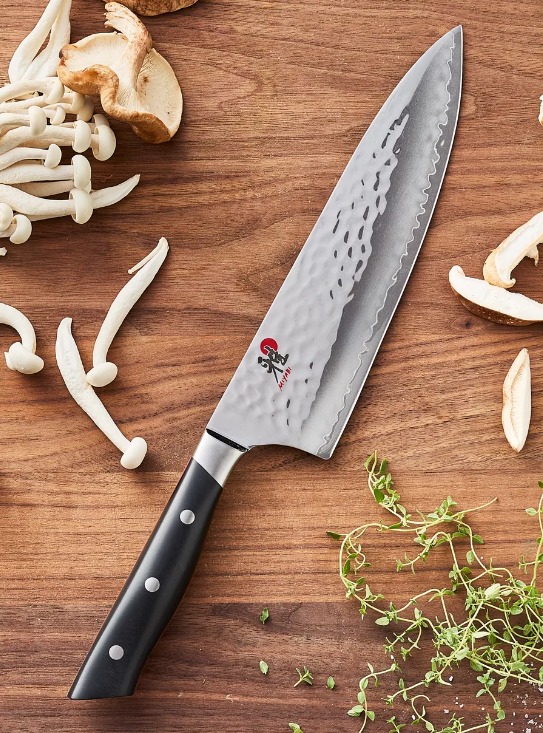

About 18 years ago I bought a Shun chef knife from Sur la Table. If you’re not familiar with Shun, they are one of the most well-known Japanese knife brands here in the states, and have been a staple at big kitchen shops like Bed Bath & Beyond and Sur la Table for years.
They are known to be very well made and mine was a testament to that reputation. This year when I took it in for sharpening I decided it was time to get a new knife. The Shun was still fine, but it was finally starting to show its age. Admittedly, I have not always been as careful with it as I should have been, but now that I am older and more focused on my kitchen, it was time.
I was looking at the knife display, one of the coolest spots in any kitchen shop, and another Japanese brand caught my eye, Miyabi. I had heard of them before, but they certainly didn’t have the broad appeal and recognition that Shun had gathered thus far. The more I looked at the Maiyabi blades, though, the more I began to wonder why. If you’re as into quality cooking gear as I am, you’ll know that there is a certain kind of aesthetic appeal to a really good knife, and the blades from Japan are often the most striking of the lot. Miyabi’s price points were comparable, a bit higher but not so bad I would call it out, but the metal was absolutely stunning. Damascus patterns that looked like ice crystals, gleaming chrome hand-hammered divots, glistening edged sporting the warped lines of multiple layers of steel… these knives were truly beautiful to behold. I went to ask about them and was immediately told by an extremely enthusiastic “knife specialist” that the Miyabis were the sleeper hit of the store. Sure, Shun got a lot of press, but these were the “step up” in most circumstances. Well after all the hype I had to give them a test. I tried three Miyabi blades, the Hibana, the Kaizen II and the Hisho. Take a look at these beauties!
The Hibana The Kaizen II The Hisho
They are all excellent as display pieces, but let me tell you, they all felt great. The Hibana and the Kaizen both had extremely light blades with a delicate feel that was simply astounding. I liked the fit of the German style handle on the Hibana better, but the steel pattern on the Kaizen caught my eye better. They both cut comparably, razer sharp and quick. There was something about them that felt fragile to me, though. The blades are so thin that pressing down on the spine too hard was a bit uncomfortable for me and my big hands, and as much as I knew they were extremely sturdy, I just felt like I was going to break them. Then I tried the Hisho.
The Clear Winner
This knife checked all my boxes for a general kitchen workhorse. It had the more grip-curved German style handle I liked from the Hibana (not as pretty as the natural wood handle, but much more comfortable) but the blade was a few ounces heavier and had a nice sturdy spine.
If you’ve used both Japanese and German knives, you’ll know that a German knife is much thicker at the spine. It gives them a heft and strength that is admirable, but the extra width ends up parting food more aggressively and can make for some harder work on things like carrots and potatoes. The trade-off for the thinner, sharper Japanese steel is strength and press comfort. The Hisho stands squarely in the middle, with the sharpness and alure of a katana (samurai sword), and the heft and chopping power of a German war sword. It immediately felt wonderful to hold. The hammered steel, polished to a mirror shine, looks absolutely fantastic and makes cleaning a breeze. Food bits just slide right off the thing. The 8 inch chef knife I tested is an excelent balance of a slicer, chopper and delicate operator all in one.
Needless to say I left with the knife, spending a tidy $164.98 after a pretty nice sale they have running on the blade at Sur la Table. I took it home and went to work prepping a dish that I knew would test every fascet of the blade… beef pot roast.
The Hisho in Action
Pot roast is one of those meals that requires a good bit of prep, but doesn’t really need every tool in the kitchen. It puts your pan, your crock pot and your knife to good use, and that’s exactly what I was going for here. Let’s walk through the process with the new Hisho knife in-hand.
First comes the meat. I had a 3lb chuck roast cut that I got on sale which I scored and seasoned with salt and pepper. I scored the meat by lightly drawing the edge of the knife over the meat, not pressing at all. The knife was so sharp that it gave me a perfect score in one pass. No sawing, no tip-gouging, just a straight line at an angle, three going one direction, three crossing over them in the other. This lets me get a bit more seasoning into the meat’s surface area, and locks some of it in when I heat up a few tablespoons of olive oil on the skillet and sear all sides of the roast.
Once the flavor was locked in with a sear, I set it aside and got to work on the onions and garlic. Onions are one of those veggies you see used in knife demonstrations all the time and the reason for that is clear. Once you slice the onion in one direction, turning the knife and cutting the opposite direction without the layers of the onion separating all over the place is such a nice feeling. This knife went through that onion like a light saber. Once the onion is diced, into the skillet with the leftover oil and juices from the roast it goes. Now onto the garlic. Removing the outer layer was a dream with the incredibly sharp tip of the knife, and the divots in the side of the blade made for easy crushing of the segments. Then a quick razor sharp dice with very little garlic stuck to the blade and into the skillet it went.
Then, after a quick sautee of the ingredients, the Crock Pot is ready for its first layer. Onions and garlic went in, and I deglazed the pan with some beef broth, dumping the whole mixture into the pot.
Now it’s time for the real test, the carrots and potatoes. I think by this point it’s obvious how that went. The knife went through the tough root veggies with minimal effort. The thin blade really shone here, not making me fight a thick wedge to cut such sturdy vegetables. I had to push, sure, but it was so easy I felt like I was cheating. Chop chop chop and into the Crock Pot around the meat went the roots. Once the lid was on, it was just 6 hours on high heat until a beautifully prepped savory delight was ready to eat!
Final Thoughts
All in all, I couldn’t be happier. Sure, I liked the fancy damascus steel of the other two blades, but the Hisho is an absolutely divine knife that made quick work of every task my kitchen could throw at it. If you’re looking for a good knife and have a bit of money to spend, I highly recommend the Miyabi Hisho 8” chef’s knife!
About the Author:
Ever since a young George was disappointed with a toy that did match up to the advertising, he became a tireless advocate for consumers. He’ll review anything that folks have to spend their hard-earned dollars on. George is grateful that he gets to use his skills as a writer and an artist to help connect with consumers and help them make the best decisions possible.
This article is for informational purposes only and reflects the author’s independent opinion. Readers should verify details directly with the manufacturer or retailer before making a purchase decision.